
How Many Rakats in Isha Salah? (Full Breakdown)
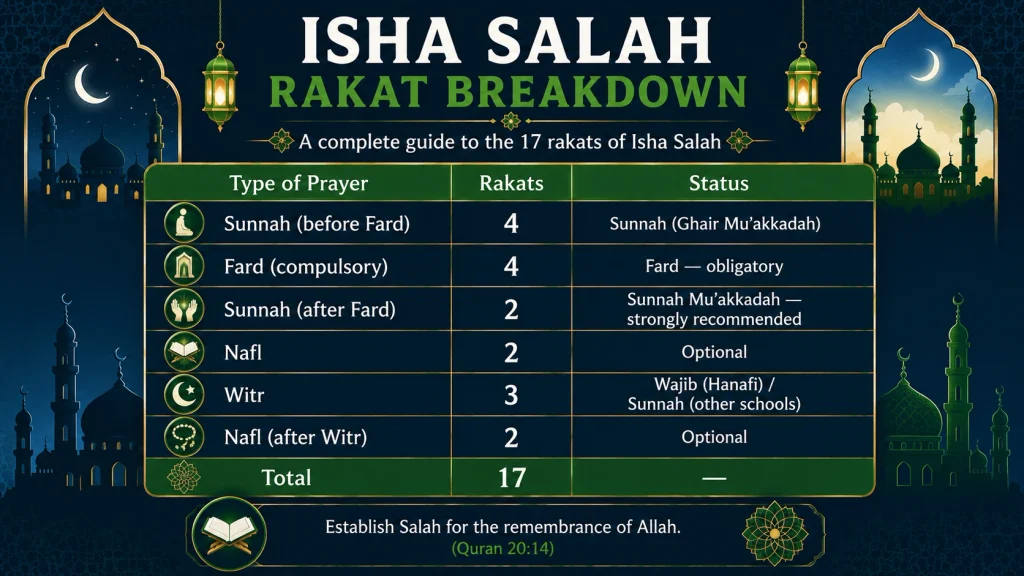
Isha prayer has 4 obligatory (Fard) rakats. Including the recommended Sunnah, optional Nafl, and Witr, the complete Isha prayer as most commonly practiced totals 17 rakats. Only the 4 Fard rakats are strictly obligatory in Salah — the rest are recommended (Sunnah) or optional (Nafl), except Witr, which is obligatory (wajib) according to the Hanafi school and a strongly emphasized Sunnah according to the other schools of thought.
Isha Salah Rakat Breakdown
| Type of Prayer | Rakats | Status |
|---|---|---|
| Sunnah (before Fard) | 4 | Sunnah (Ghair Mu’akkadah) |
| Fard (compulsory) | 4 | Fard — obligatory |
| Sunnah (after Fard) | 2 | Sunnah Mu’akkadah — strongly recommended |
| Nafl | 2 | Optional |
| Witr | 3 | Wajib (Hanafi) / Sunnah (other schools) |
| Nafl (after Witr) | 2 | Optional |
| Total | 17 | — |
Explore other chapters of the Quran too — see the Benefits of Surah Yaseen or read Surah Rahman, known for its repeated theme of Allah’s mercy.
What Is Isha Salah?
Isha is the fifth and final prayer of the day, prayed after the red twilight disappears from the sky and continuing until midnight (according to most scholars) or until Fajr begins, according to others. It closes a Muslim’s day with worship and reflection.
Step 1: Wudu (Ablution) Before Isha Salah
- Make niyyah (intention) in your heart, for the sake of Allah.
- Say Bismillah before starting.
- Wash hands up to the wrists, three times.
- Rinse the mouth, three times.
- Rinse the nose by inhaling water lightly and blowing it out, three times.
- Wash the face from forehead to chin, ear to ear, three times.
- Wash the arms up to the elbows, starting with the right, three times each.
- Wipe the head (masah) once with wet hands.
- Wipe the ears with wet fingers.
- Wash the feet up to the ankles, starting with the right, three times each.
- Recite the dua after wudu: “Ashhadu an la ilaha illallahu wahdahu la sharika lahu wa ashhadu anna Muhammadan abduhu wa rasuluhu.”
The Prophet ﷺ is reported to have said that performing wudu perfectly brings forgiveness of minor sins.
Step 2: Niyyah (Intention) for Isha Salah
Before starting, make a simple intention in your heart — for example: “I intend to pray four rakats Fard of Isha for Allah, facing the Qiblah.”
Step 3: How to Perform Isha Salah, Step by Step
1. Four Rakats Sunnah (Ghair Mu’akkadah)
Optional but recommended. Recite Surah Al-Fatiha and another surah in each rakat; sit for Tashahhud after 2 rakats, then complete the next 2.
2. Four Rakats Fard (Obligatory)
The compulsory core of Isha. For each rakat:
- Takbir al-Ihram — raise the hands and say “Allahu Akbar.”
- Qiyam — recite Surah Al-Fatiha plus another surah (e.g. Al-Ikhlas, Al-Falaq, An-Nas).
- Ruku — bow, saying “Subhana Rabbiyal Azeem” three times.
- Qaumah — stand, saying “Sami Allahu liman Hamidah, Rabbana lakal hamd.”
- Sujood (twice) — prostrate, saying “Subhana Rabbiyal A’la.”
Repeat for all 4 rakats. Sit for Tashahhud after the second rakat, and complete Tashahhud, Durood, and dua before ending with Salam in the fourth.
3. Two Rakats Sunnah (Mu’akkadah)
Prayed the same as a normal Sunnah prayer.
4. Two Rakats Nafl
Optional, for additional reward.
5. Three Rakats Witr
Obligatory (wajib) in the Hanafi school. The first 2 rakats are prayed normally; in the third, after Surah Al-Fatiha and another surah, raise the hands and recite Dua-e-Qunoot: “Allahumma inna nasta’inuka wa nastaghfiruka…”, then complete the prayer.
6. Two Rakats Nafl (Optional)
Can be prayed after Witr for additional reward.
What to Recite in Isha Salah
- Surah Al-Fatiha is mandatory in every rakat.
- Common short surahs recited afterward include Al-Ikhlas, Al-Falaq, An-Nas, and Al-Kafirun.
- In longer prayers, longer surahs such as Al-Baqarah or Al-Imran may be recited.
After Isha Salah: Dhikr and Dua
Dhikr: After Isha, it’s recommended to recite Tasbeeh (SubhanAllah, 33 times), Tahmeed (Alhamdulillah, 33 times), and Takbeer (Allahu Akbar, 34 times). Many also recite Ayat al-Kursi and the last two verses of Surah Al-Baqarah before sleeping, which are reported to offer protection through the night.
Witr and sleep: Witr is typically prayed after Isha, before sleeping, closing the day’s prayers. It’s also widely practiced to recite Surah Mulk before sleeping — it’s reported in a hadith (Jami’ at-Tirmidhi 2891, graded hasan) that reciting it protects the reciter from the punishment of the grave, which is why many scholars encourage it as a regular nightly habit. Sleeping soon after makes it easier to wake for Tahajjud or Fajr.
Dua: The night is considered a time when supplication is especially encouraged. Common duas after Isha include seeking forgiveness (Astaghfirullah, 3 times), Ayat al-Kursi, the closing verses of Al-Baqarah, and Tasbeeh Fatimah before sleeping — along with personal dua in your own words. Sincerity matters more than eloquence.
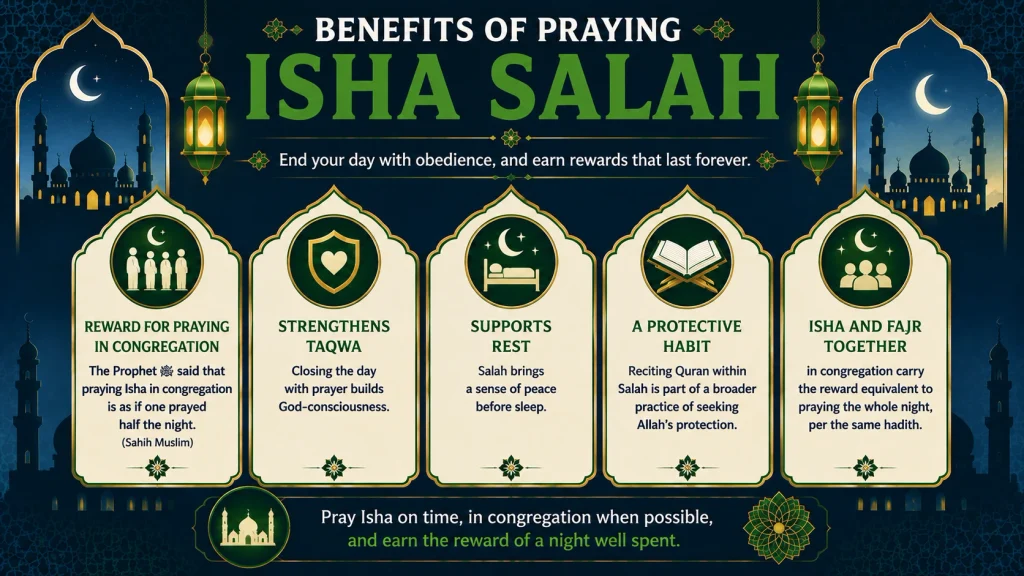
Benefits of Praying Isha Salah
- Reward for praying in congregation — the Prophet ﷺ said that praying Isha in congregation is as if one prayed half the night (Sahih Muslim).
- Strengthens taqwa — closing the day with prayer builds God-consciousness.
- Supports rest — Salah brings a sense of peace before sleep.
- A protective habit — reciting Quran within Salah is part of a broader practice of seeking Allah’s protection.
- Isha and Fajr together in congregation carry the reward equivalent to praying the whole night, per the same hadith.
Common Mistakes in Isha Salah
- Rushing through rakats without proper recitation
- Skipping the Sunnah prayers, assuming only Fard is required
- Neglecting Witr, despite its strong emphasis
- Losing khushu (focus and humility) during prayer
Frequently Asked Questions
How many rakats are compulsory in Isha Salah?
Only 4 — the Fard rakats. Everything else (Sunnah, Nafl, Witr) is recommended or, in Witr’s case, obligatory specifically in the Hanafi school.
How many rakats in total, including Sunnah and Witr?
17 rakats in total, when counting Sunnah, Fard, Nafl, and Witr together.
Can Isha be prayed late at night?
Yes — Isha’s time extends until midnight, or until Fajr according to some scholars, though praying earlier is preferred.
Is Witr compulsory?
According to the Hanafi school, Witr is wajib (obligatory). Other schools consider it a strongly emphasized Sunnah rather than obligatory.
Can Isha be combined with Maghrib?
Only in specific circumstances such as travel or hardship, according to some scholars.
Can I pray Isha sitting down?
Yes, if you’re unable to stand due to illness or another valid reason.
What if I miss Isha prayer?
Pray it as qada (a makeup prayer) as soon as you’re able to.
What is the reward for praying Isha in congregation?
It’s described as equivalent to praying half the night; combined with Fajr in congregation, it’s described as equivalent to praying the whole night (Sahih Muslim).