
Laylat al-Qadr 2027: Significance, Prayers & How to Seek It
Laylat al-Qadr — the Night of Decree, or Night of Power — is one of the most spiritually significant nights in the Islamic calendar. It falls within the last ten nights of Ramadan and is described in the Quran as a night better than a thousand months. This guide covers its significance, when to expect it in 2027, and how to prepare.
Note: Ramadan’s start is confirmed by moon sighting, so every date below is a well-informed estimate, not a certainty — always confirm with your local mosque or national Islamic authority as Ramadan approaches.
For deeper reflection during these nights, see our Surah Yaseen Tafseer for verse-by-verse commentary.
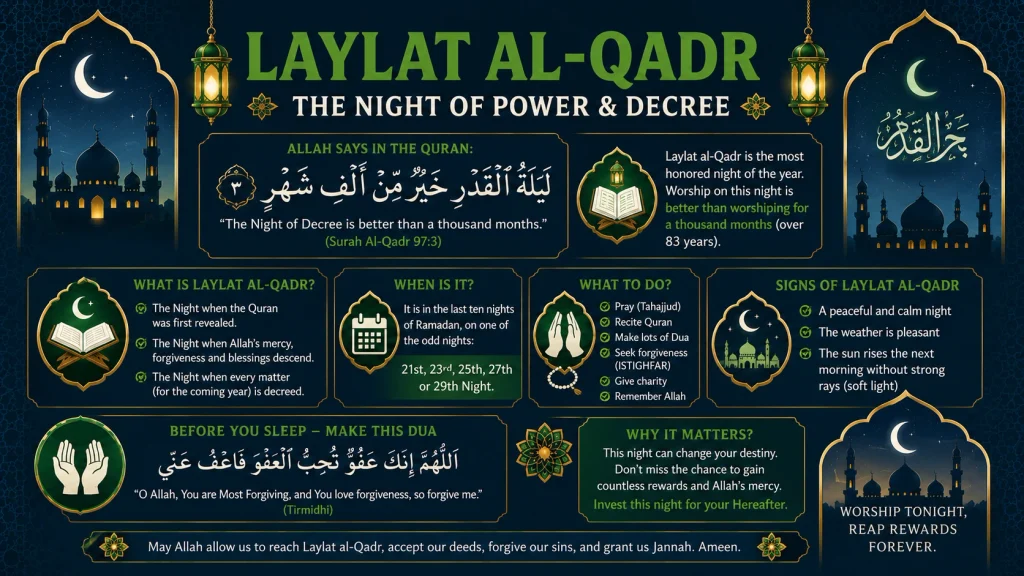
What Is Laylat al-Qadr?
Laylat al-Qadr is the night the Quran was first revealed to Prophet Muhammad ﷺ through the angel Jibreel (Gabriel) — a turning point marking the beginning of the Quran’s revelation to humanity.
Allah describes it directly in Surah Al-Qadr (Chapter 97): the night is better than a thousand months, angels and the Spirit descend by their Lord’s permission for every matter, and peace prevails until the emergence of dawn. Since a thousand months is just over 83 years, worship on this single night is described as outweighing worship across a period longer than most people’s entire lives.
When Is Laylat al-Qadr 2027?
The exact night is not fixed or publicly known — this is intentional, encouraging worship across all of the last ten nights rather than a single date. It’s traditionally sought on the odd nights: the 21st, 23rd, 25th, 27th, and 29th nights of Ramadan.
For 2027, with Ramadan expected to begin around February 8 (pending moon sighting), the last ten nights fall roughly between February 27 and March 8, 2027, with the odd nights landing approximately:
- 21st night: ~February 28, 2027
- 23rd night: ~March 2, 2027
- 25th night: ~March 4, 2027
- 27th night: ~March 6, 2027 (the night most commonly observed)
- 29th night: ~March 8, 2027
The Prophet ﷺ advised seeking it across all of the last ten nights rather than relying on the 27th alone, even though it’s the most widely observed.
The Significance of Laylat al-Qadr
- The Quran’s revelation began this night — the origin of divine guidance for all believers.
- Better than a thousand months — worship, charity, and good deeds are described as multiplied far beyond an ordinary night.
- Sincere seeking of forgiveness is met with forgiveness — a night particularly associated with wiping away past sins for those who spend it in genuine worship.
- Angels descend — the night is described as filled with peace, continuing until dawn.
Traditional Signs of Laylat al-Qadr
While the exact night isn’t confirmed in advance, some signs are described in hadith for recognizing it may have passed, most notably: the sun rising the following morning without its usual sharp rays — appearing calm, like a flat disc, rather than intensely bright (reported in Sahih Muslim). Scholars note this is a sign to reflect on afterward, not something to actively search for during the night itself — the focus should remain on worship, not sign-spotting.
How to Prepare for Laylat al-Qadr
- Increase Quran recitation — aim to complete a fuller reading, or dedicate meaningfully more time to it than usual.
- Pray extra voluntary prayers (Nawafil) — including Tahajjud, beyond the obligatory five.
- Make sincere dua — consider writing down what you want to ask Allah for in advance, so you’re not searching for words in the moment.
- Give charity — many increase giving specifically during these nights.
- Practice i’tikaf — a period of dedicated seclusion in the mosque, typically observed by some Muslims for all or part of the last ten nights, spent in continuous worship, reflection, and minimal worldly distraction.
The Recommended Dua for Laylat al-Qadr
The Prophet ﷺ taught Aisha (RA) this dua specifically for this night, reported in Jami’ at-Tirmidhi and Sunan Ibn Majah and graded sahih by a number of scholars, including Al-Albani:
“Allahumma innaka ‘afuwwun tuhibbul-‘afwa fa’fu ‘anni” (“O Allah, You are Most Forgiving, and You love forgiveness, so forgive me.”)
Short, but comprehensive — centered entirely on forgiveness, which fits the essence of what the night is about.
Acts of Worship on Laylat al-Qadr
- Tahajjud — night prayer offered for closeness to Allah.
- Reciting Quran — with reflection on its meaning, not just recitation speed.
- Dhikr — SubhanAllah, Alhamdulillah, La ilaha illallah, Allahu Akbar.
- Charity and kindness — even small acts count meaningfully on this night.
- Salawat upon the Prophet ﷺ — increased Durood as an act of devotion.
A Sample Night Structure
This is a flexible guide, not a required format — adjust based on your own schedule and energy:
| Time | Activity |
|---|---|
| After Isha | Tahajjud / extended night prayer, in sets of two rakat |
| Late night | Quran recitation with reflection — increase beyond your usual amount rather than targeting a specific fixed count |
| Following | The dua above, repeated with sincerity |
| Early morning | Dhikr, reflection on what you’ve recited, voluntary prostration |
| Before Fajr | I’tikaf (if practicing it), charity, and personal dua |
Frequently Asked Questions
When is Laylat al-Qadr 2027? Most likely within the last ten nights of Ramadan, expected to fall roughly between February 27 and March 8, 2027, with the 27th night (around March 6) most commonly observed — though the exact date depends on moon sighting and isn’t confirmed until Ramadan begins.
Why isn’t the exact date known? It’s understood to be intentionally hidden so believers seek it through sincere worship across the last ten nights, rather than focusing effort on a single date.
What’s the best dua to recite on Laylat al-Qadr? The dua taught by the Prophet ﷺ to Aisha (RA) — “Allahumma innaka ‘afuwwun tuhibbul-‘afwa fa’fu ‘anni” — is well-sourced and centers specifically on seeking forgiveness.
Do I need to recite a specific number of times to benefit? No — there’s no fixed required count for recitation on this night. Sincerity and consistency matter more than hitting a specific number.
Can women observe Laylat al-Qadr during menstruation? Yes — dhikr, dua, and reflection remain fully available. For guidance on Quran recitation specifically during menstruation, see a resource like IslamQA for rulings specific to your school of thought.